How Your Paycheck Works
You landed the job, and after years of school, training, or simply working hard to get your foot in the door, your first real paycheck finally arrives. You log into your bank account expecting to see a number that feels life-changing. Then reality kicks in. A significant part of your check went to taxes, benefits, and retirement savings.
Understanding your paycheck is one of the first steps toward financial freedom. You need to understand how money flows from your employer to your bank account. This lesson will show you exactly how that process works and what each deduction means.
Your primary income will likely be from your paycheck directly deposited into your personal checking account. Gross pay is your total annual pay divided by the company’s pay periods, usually 24 or 26. Net pay is your gross pay minus deductions such as taxes, benefits, retirement contributions, etc., and that amount actually hits your bank account.
According to the U.S. Bureau of Labor Statistics, the median annual earnings for fulltime workers ages 20–24 in 2025 is about $42,000 per year* and will be used for this illustration. Actual starting salaries can vary significantly depending on factors such as education, industry, geographic location, certifications, and prior work experience, but use this example to understand the concepts.
Let’s assume the following circumstances:
Gross pay: $42,000 per year and the only source of income
Pay periods: 24 (2x /month) = $1,750 gross pay per pay period
Federal tax: $125 per pay period
Social Security tax: 6.2% of gross pay per pay period
Medicare tax: 1.45% of gross pay per pay period
Health insurance deduction: $50 per pay period
401(k) contribution: 6% of gross pay per pay period
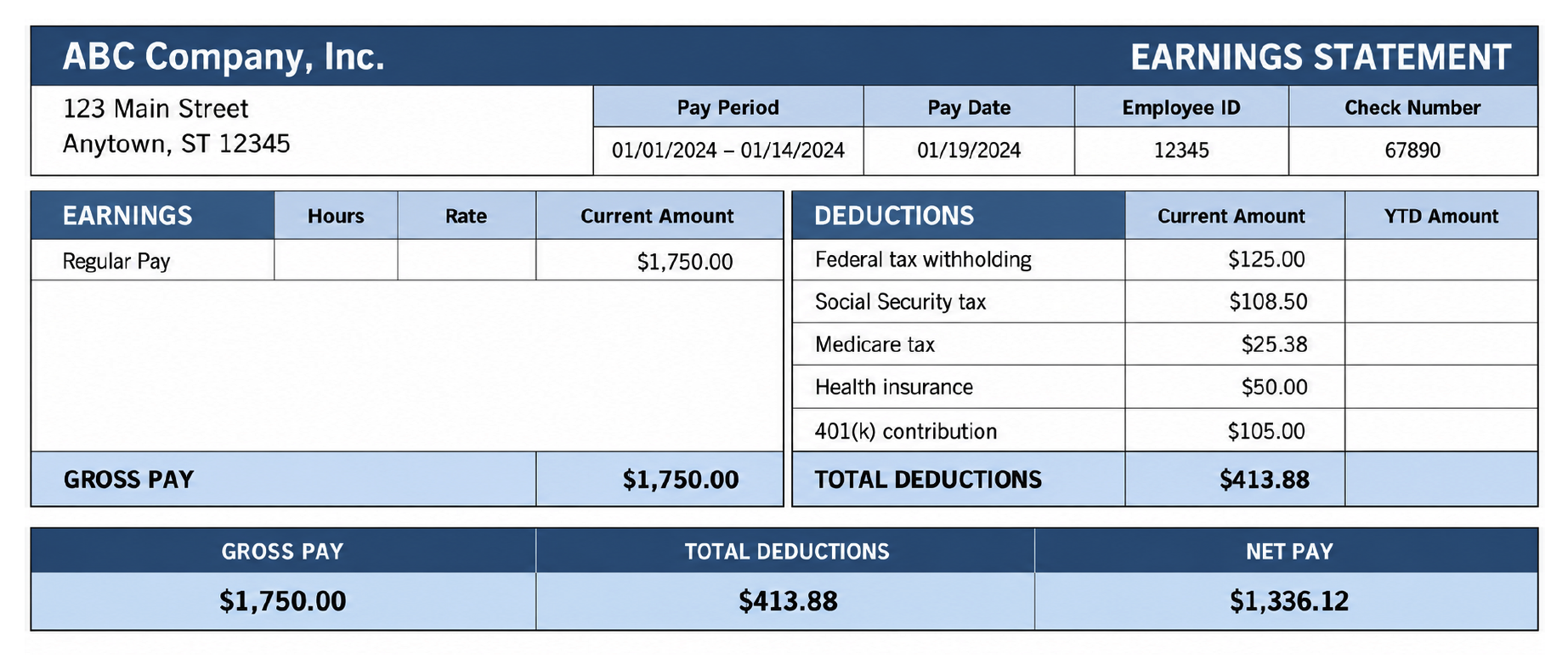
Your net pay per pay period equals $1,336.12:
Gross pay: $1,750.00
Less: Federal tax withholding $125.00
Social Security tax $108.50
Medicare tax $ 25.38
Health insurance $ 50.00
401(k) contribution $105.00
Deductions: $ 413.88
Net pay $1,336.12
You can see how quickly payroll deductions can add up, reducing your gross pay each period, in this case, by almost 25% from some basic deductions. Of course, some deductions can be revised or not incurred all-together. But before you begin removing or reducing any of these common deductions, let’s look at each one from the illustration to understand how they are calculated and the benefits and consequences of changes.
Federal Withholding Taxes
When you begin your job, you will be asked to complete Form W-4, Employee’s Withholding Certificate. This Internal Revenue Service (“IRS”) form is completed by employees to tell their employer how much Federal income tax should be withheld from their paycheck and submitted to the IRS. Based on your selections on the form, such as marital status, number of dependents, etc., your Federal tax withheld from each paycheck will be calculated. However, this tax can generally be any amount you want it to be, even $0. Really!
So why not make the Federal tax withholding $0 and have a little fun with that extra money? Because the Federal tax withheld will be credited against your taxes due when you file your Federal tax return each year. If you withhold $0 Federal tax, and your tax owed is calculated as, for example, $4,000 at tax time, not only will you owe the $4,000 tax, you will owe penalties and interest on the $4,000 because you did not have enough Federal tax withheld and paid in to the IRS during the year from each paycheck.
My advice – never make it $0! Take the time to make an informed decision on what the amount should be so that you don’t underpay your taxes throughout the year and have to come up with a large check at tax time. See lesson Completing Your W-4, Employee’s Withholding Certificate to learn how to compute the best estimate for your Federal tax withholding.
Contrary to the mistake of having too little Federal tax withheld, it’s an even bigger mistake to have too much Federal tax withheld from your paycheck. This option is the equivalent of using the IRS as a savings account. Some want to make sure they get a big refund when they file their taxes at the end of the year, in part because they don’t trust themselves to compute and pay the correct amount throughout the year. They look forward to receiving that big refund check and spending it on something they would not otherwise have saved for.
Everything about this approach is wrong because you are giving the government an interest-free loan with your money all year long instead of keeping control of it yourself. That money could have been earning interest, helping you build an emergency fund, paying down debt, or being invested for your future. A tax refund is not “free money.” It is your money being returned to you from the IRS after you allowed too much to be withheld from your paycheck throughout the year. While getting a large refund may feel exciting, financially it usually means you mismanaged your cash flow during the year.
Try to be as accurate as you can when completing the W-4 so that you don’t overpay or underpay by any material amount. When I was just starting out like you, I considered my Federal tax withholding choice to be a success if I were plus or minus $500 of receiving a refund or paying taxes owed. That meant I’d properly estimated my Federal tax withholding and kept more of my money working for me throughout the year instead of letting it sit with the IRS. Understanding this concept early in life is important because financial freedom is built through your intentional decisions.
Social Security Tax
Social Security tax is a Federal payroll tax deducted from your paycheck to help fund the Federal Social Security program, which provides retirement, disability, and survivor benefits to eligible Americans. Employees contribute a percentage of wages through payroll taxes and employers match that amount.
The money is deposited into the Federal government's Social Security trust funds. It is not placed into an individual account with your name on it. As you work and pay Social Security taxes, you earn "credits" and build a record of your earnings. Later, that record is used to calculate your future benefits. Most people qualify after earning 40 credits, which generally requires about 10 years of work.
A common misconception is that your Social Security taxes are being invested for you like a 401(k). They are not. Your future benefit depends largely on how much you earned during your career, how many years you worked, and the age at which you claim benefits. Social Security benefits generally become available at age 62; however, waiting longer increases your monthly benefit. Most people receive their full benefit at age 67, and the largest benefit at age 70.
The current Social Security tax is 6.20% of your gross pay within certain wage limits. You may see Social Security represented on you pay stub by the acronym OASDI which stands for Old-Age, Survivors, and Disability Insurance, the official name for the Social Security tax.
You can set up an account on the Social Security Administration website which lets you verify your earnings history each year, see estimates of future retirement benefits, get a replacement Social Security card, and other services. The most important reason to create an account early is to protect your identity. If you create the account first, it is much harder for someone else to fraudulently create one using your Social Security number**.
Medicare Tax
The Medicare tax is a Federal payroll tax that helps fund the Medicare program, which provides health insurance primarily for individuals age 65 and older, as well as certain younger individuals with disabilities. Unlike Social Security tax, Medicare tax does not have a wage limit.
The current Medicare tax is 1.45% of your gross pay; so, if you earn $60,000 gross wages for the year, you will have $870 deducted; if you earn $600,000 gross wages for the year, you will have $8,700 deducted. You may sometimes hear the term FICA which stands for Federal Insurance Contributions Act signed into law by President Roosevelt in 1935. FICA actually consists of two payroll taxes, the OASDI (Social Security) and Medicare.
Health Insurance
Health insurance premium contributions are the portion of health insurance costs paid by the employee through payroll deductions. In many employer-sponsored plans, the employer pays a significant share of the premium, while the employee pays the remaining portion based on the type of coverage selected.
Young employees can be tempted to opt out of coverage because they feel healthy or want a larger paycheck each pay period. However, declining health insurance can be a costly mistake, one for which you could spend years trying to correct. A single accident or unexpected illness can create serious financial hardship without coverage. Employer-sponsored plans are often far less expensive than obtaining insurance independently because the employer subsidizes much of the cost.
Many young adults have an option that can save thousands of dollars each year. Under current law, most employer-sponsored and individual health insurance plans allow children to remain on a parent's health insurance policy until age 26, even if they are financially independent, married, employed, or no longer living at home. If this option is available to you, take advantage of it!
Your parent should be able to determine how much of their total health insurance premium is allocated to the children from their employer, and then make sure you reimburse your parent for this amount even if they offer to cover your cost. You’re an adult with a job, now, so be independent in all ways that you can.
In some situations, coverage may continue beyond age 26 if you qualify under specific plan rules, such as certain disability provisions. Check with the insurance provider or your parent's employer to understand your options and any deadlines for obtaining your own coverage.
Before you assume you need to buy health insurance on your own, make sure you understand all of the coverage opportunities available to you. An internet search, and AI prompt, or a simple phone call could save you thousands of dollars. Health insurance is not just protection for your health. It is protection for your financial future.
401(k) Contribution and Other Deductions
A 401(k) is an employer-sponsored retirement savings plan that allows employees to save and invest money for retirement directly from their paycheck. Contributions are typically deducted before taxes, which can reduce your taxable income See lesson Employer-sponsored Retirement Plans for an in-depth discussion.
Other common paycheck deductions include state and local taxes, dental insurance, vision insurance, life insurance, disability insurance, union dues, and Health Savings Accounts, (HSAs) to name a few. The list is endless, so make sure you know the benefits offered by your employer and understand the taxes and any other deductions from your paycheck.
Final Thoughts
It’s your responsibility to understand how your paycheck works and the benefits your employer offers so you can make the most of them. Ask questions, seek out information, and take the time to understand the options available to you. Don’t assume someone else will make sure you know everything you need to know.
I hope this lesson has given you a solid foundation on how your paycheck works. Remember, you don't have to know everything from the start. What matters is being willing to learn, and every step you take toward understanding your finances is a step toward greater financial freedom.
Very truly yours,
Aunt Anna